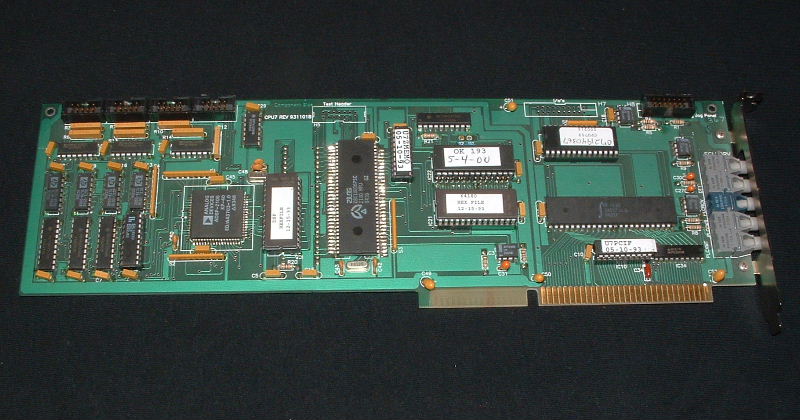
Full-length (13") ISA board with 2105 DSP, four encoder inputs, five fiber optic sockets. Can operate only DC servo and OPTIC1 control systems.
Centroid CNC control sales, service, training and support
These are CPU boards used in Centroid CNC controls from 1993 to present. Not all versions of all boards are pictured.
Full-length (13") ISA board with 2105 DSP, four encoder inputs,
five fiber optic sockets. Can operate only DC servo and OPTIC1
control systems.
Used in M10/M40 family controls and board-level controls, ca. 1993-1997


Distinctive features include stacked memory chips on front side of board, and dual-port RAM chip located on back side of board.

PC104-bus ISA board with 2101 DSP, five encoder inputs,
five fiber optic sockets. Can operate only DC servo and OPTIC1
control systems.
Silk-screening on board labels it "CPUP3".
Used in M15 and M400 controls, 1996-2001
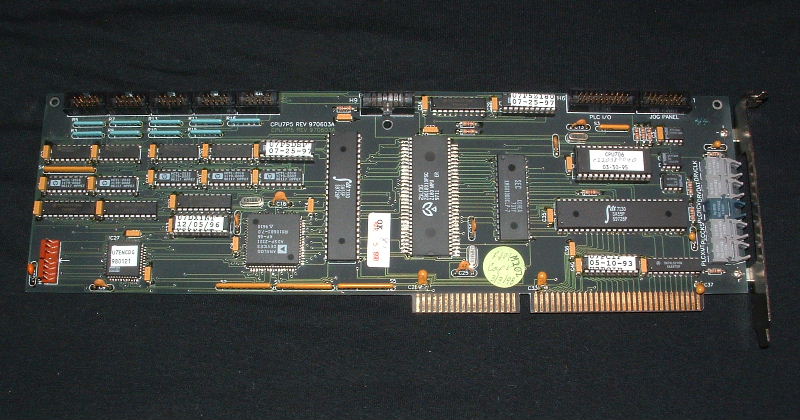
Full-length (13") ISA board with 2101 DSP, five encoder inputs,
five fiber optic sockets. Can operate only DC servo and OPTIC1
control systems.
Used in M39 and board-level controls, ca. 1997-2000
Newer technologies allowed all components to fit on the front of the board. The stacked RAM chips were replaced with a single higher-capacity chip.
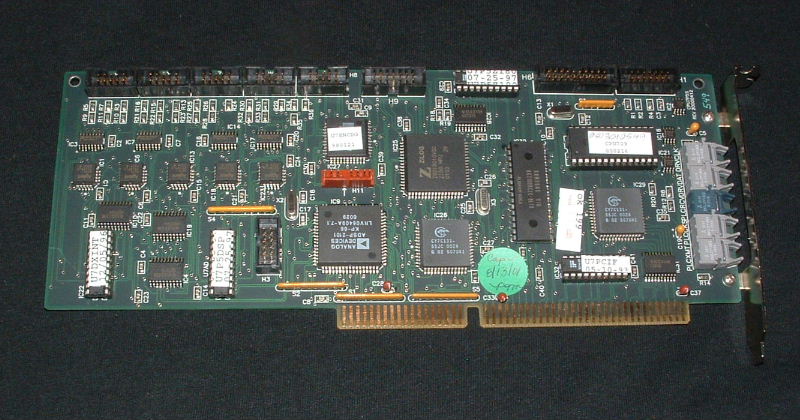
Short (10.5") ISA board with 2101 DSP, five encoder inputs,
five fiber optic sockets. Can operate only DC servo and OPTIC1
control systems.
Used in M39 and board-level controls, ca. 2000-2003
The original version of this board, REV20000412 pictured above, has the encoder inputs lined up along the long edge. The later version, REV020924 pictured below, has the encoder inputs stacked along the short edge.
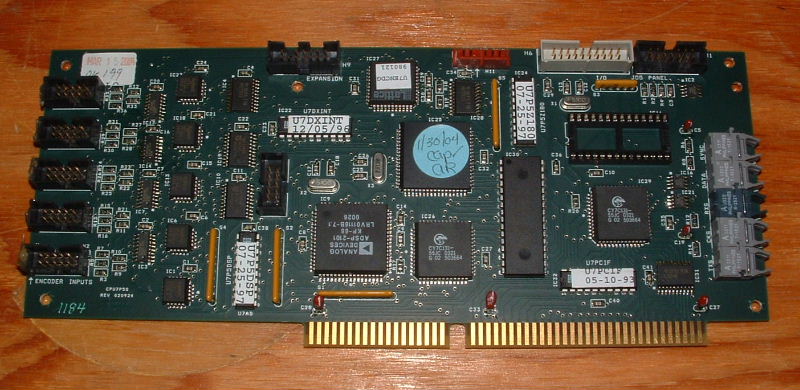

Short (10.5") ISA board with 2101 DSP, seven fiber optic sockets,
no on-board encoder inputs. Can operate only AC servo control
systems.
The original CPU9 board worked only with the SERVO4 drive unit. A minor hardware change yields a CPU9SD board such as the one pictured above, for use with the SD3 and SD1 drives.
Used in M39 and M400 AC-servo controls, ca 2003 - 2004.
This board is identified simply "CPU10", but is now called CPU10A to distinguish it from the CPU10B board released in 2006.
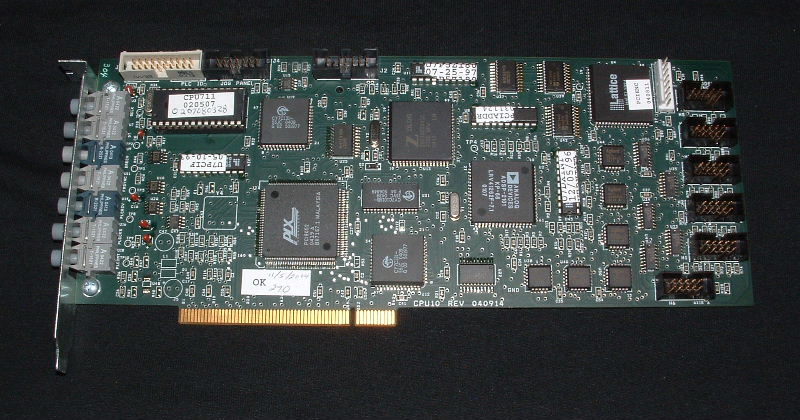
Short (10") PCI board with 2101 DSP, six encoder inputs, socketed PIC,
seven fiber optic sockets. Can operate both DC servo, AC servo
and OPTIC1 control systems.
Used in all controls ca. 2004 - 2006.
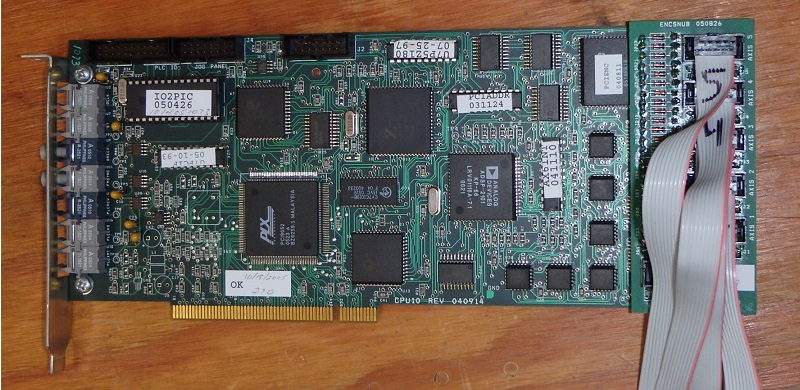
The encoder inputs can be damaged by a shorted encoder, and so should
be protected by a piggyback snubber board, as on the board shown here.
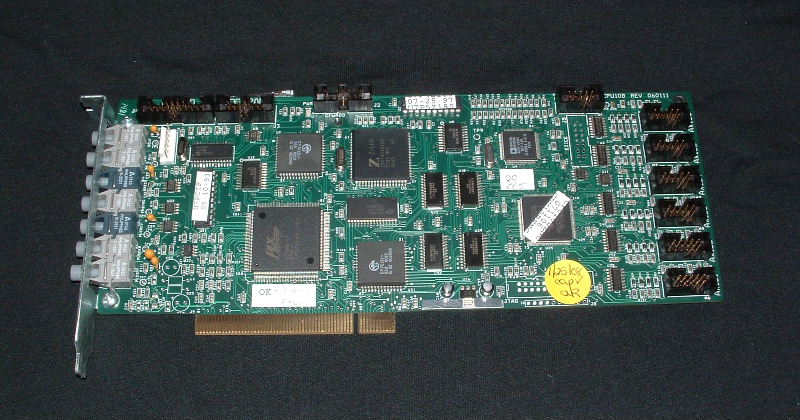
Short (10") PCI board with 2101 DSP, six encoder inputs,
surface-mount PIC, seven fiber optic sockets. Can operate
DC servo, AC servo and OPTIC1 control systems.
Used in all control models, ca. 2006 - 2010.
The encoder inputs have built-in snubber protection, and therefore do not require the piggyback board like the CPU10A.

12" x 5" Panel-mount board with Altera Cyclone processor, six encoder inputs,
four fiber optic sockets. Works with GPIO4D combined PLC and third-party
drive interface; with DC3IOB combined PLC and DC servo drive; and with
OPTIC4 third-party drive interface.
Instead of plugging into an expansion slot inside the control PC, the MPU11 mounts on the control panel and communicates with the PC over a dedicated ethernet link.
Used in all control models, ca. 2010 - present, but largely supplanted by the Oak and Allin1DC units which incorporate its functions.
The MPU11 uses, and requires, its own generation of PC-side control software, called CNC11 (and later, CNC12).
The functions of the MPU11 board are also built into the All-in-one DC control unit, combining the controller with PLC I/O and a 3-axis DC servo drive.
The functions of the MPU11 board are also built into the Oak control unit, combined the controller with PLC I/O and axis interface connections for up to four 3rd-party servo drives.
Copyright © 2024 Marc Leonard
Last updated 11-Jun-2024 MBL
